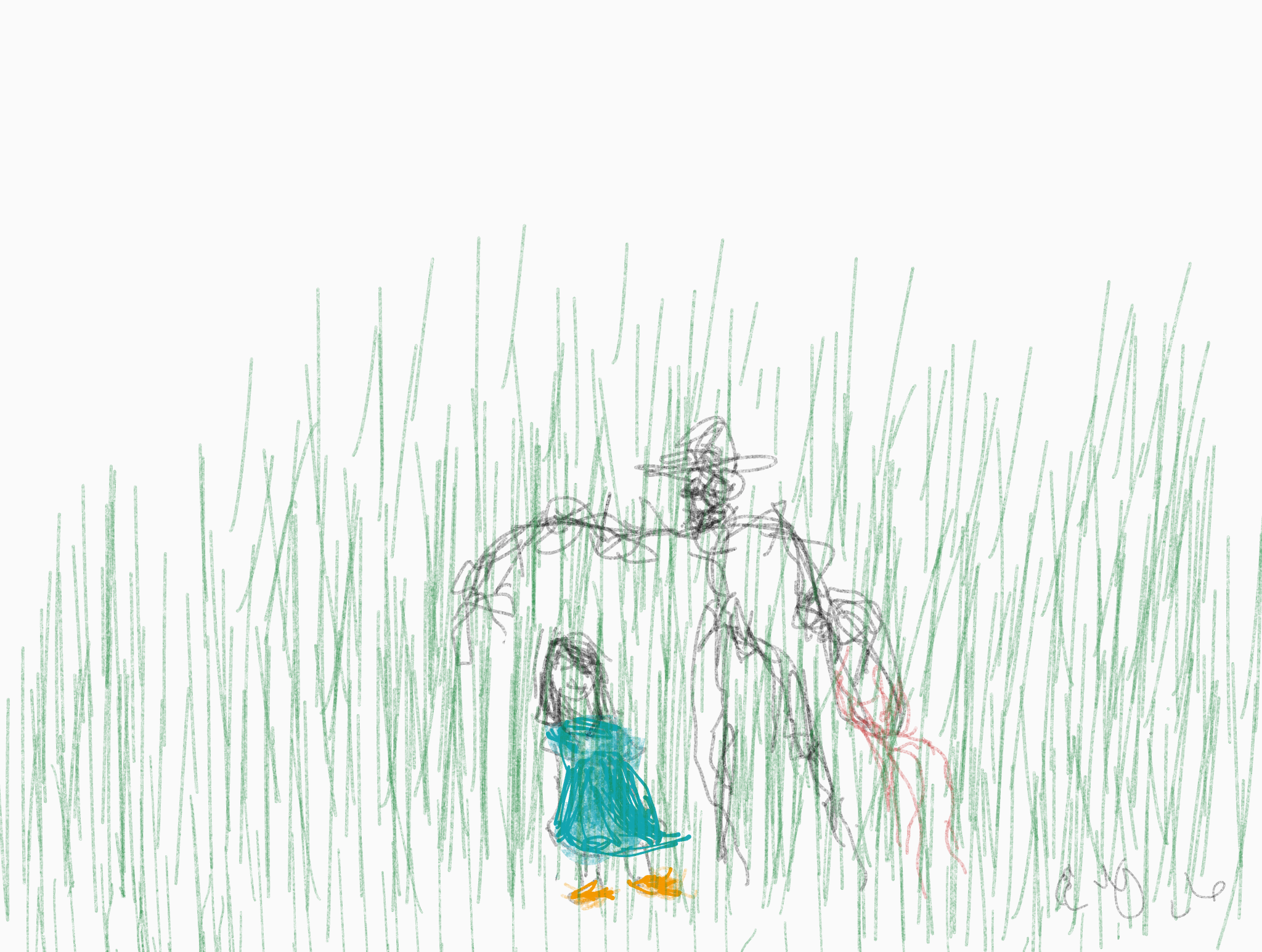
TW: acts of physical and SV are insinuated.
She only knew that after that night, Xulma did not tease her about El Silbón anymore. Not for a while. She did not call her Chía either. She returned to being bright, talkative Xulma, the girl who could make adults forgive anything and make Violeta laugh even when she did not want to.
They became inseparable.
People said it with affection at first.
There goes Xulma, and there goes her shadow.
Violeta did not mind.
After her father died, being someone’s shadow felt better than being no one’s anything.
Xulma spoke for her when teachers asked too many questions. Xulma pulled her into games. Xulma shared food from her house and secrets from other girls and stories she swore were true even when they changed a little each time she told them.
Violeta gave her loyalty in return.
The kind children give before they understand loyalty can be harvested.
Years passed that way.
The pearl stayed at Violeta’s throat.
El Silbón stayed in the trees and in the far nooks of memories.
And Xulma stayed close enough to learn every quiet thing about her.
By the time they were eleven, and fourteen, Violeta trusted Xulma with her silences.
That was the mistake.
The day everything happened, the sky was white with heat.
The girls had been sent to buy plantains and soap from a woman two roads over. Xulma had complained the whole way there and charmed two pieces of candy from the woman’s oldest son on the way back.
“You see?” Xulma said, unwrapping one with her teeth. “This is why you need me.”
“For candy?”
“For survival.”
Violeta laughed.
Xulma handed her the second piece.
The road home ran beside a stretch of trees where the shade looked almost blue. Beyond it, the land dipped toward a creek. Violeta liked that part of the walk. It smelled of wet leaves and mud, and for a few minutes the heat loosened its grip.
Then Xulma stopped.
Ahead of them, near the bend in the road, men stood by a truck.
Four of them.
Maybe five.
They wore green and brown, their rifles hanging from their shoulders like extra limbs. One of them was young. Too young, Violeta thought, to have such dead eyes.
Xulma’s candy wrapper crackled in her fist.
“Don’t look at them,” she whispered.
Violeta looked anyway.
The young one looked back.
Recognition moved across Xulma’s face so quickly Violeta almost missed it.
Almost.
“Do you know him?” Violeta asked.
Xulma did not answer.
The young man smiled.
It was not a good smile.
“Run,” Xulma said.
So they ran.
They ran through the brush, past the thin fence behind Doña Mercedes’s house, past the creek where the stones turned slick and black under moss. Branches slapped their arms. Thorns caught their skirts. Behind them, men shouted.
At first, Violeta thought it was a game her body had misunderstood. Some terrible kind of chase where if they were fast enough, clever enough, small enough, they would win.
Then a hand closed around her hair.
She hit the ground hard enough to lose the sky.
Xulma disappeared into the green.
For one bright, stupid second, Violeta hated her for it.
Then she saw Xulma crouched behind the roots of a fallen tree, both hands clamped over her mouth, eyes huge and wet and fixed on Violeta.
Do not move, Violeta wanted to tell her.
Do not come out.
One of the men held Violeta down. His hand covered her mouth. His fingers smelled like sweat and metal. She could not breathe right. She could not scream right. The world became pieces: leaves above her, dirt under her nails, a boot near her cheek, the young man standing apart from the others with his rifle held too tightly.
Someone laughed.
Someone told her to be quiet.
Then the world went away from her.
When it came back, the young man was kneeling beside her.
Not to help.
He reached for the necklace at her throat.
Violeta tried to pull away, but her body felt far from her. Like something she had left behind and might never return to.
The young man touched the pearl moon.
For a moment, his face changed.
Not kindness.
Recognition.
As if he knew exactly what he was taking.
He broke the chain with one quick pull.
Violeta made a sound then. Not a scream. Something smaller. Something worse.
The pearl moon disappeared into his fist.
Then came the whistle.
Three notes.
Falling.
Every man in the forest froze.
The one holding Violeta clamped his hand over her mouth again, harder this time.
“Shh,” he breathed.
It was the first time Violeta heard fear in a man’s voice.
The whistle came again.
Far away.
No.
Close.
No.
Both.
It moved through the trees as if the forest itself had learned to call children by name.
The man above her began to pray.
Xulma screamed.
It was not a long scream. It was not brave in the way stories make girls brave. It was wild and broken and ripped out of her before she could stop it.
The man holding Violeta turned his head.
That was all El Silbón needed.
Something long and pale unfolded from between the trees.
Violeta saw a hand first. Wet fingers curling around the trunk of a ceiba. Then an arm. Then a body too tall to belong to any living thing. El Silbon bent toward the man who had covered her mouth.
The forest went silent.
The man tried to raise his rifle.
El Silbón took him apart before he could fire.
Violeta did not understand what she was seeing. She only understood that the hand was gone from her mouth.
Air rushed into her.
Xulma burst from the roots and grabbed her.
“Get up,” she sobbed. “Violeta, get up.”
Violeta could not feel her legs.
“Get up!”
The young man with the moon necklace ran too.
For a moment, all three of them ran together: Xulma dragging Violeta by the hand, Violeta stumbling through the brush, the young man crashing beside them with terror bright on his face.
Behind them, El Silbón whistled once.
The young man looked back.
Xulma did not.
At the creek, the young man went left.
The girls went right.
They never saw him again.
They did not stop running until the trees thinned and the first houses appeared through the rain.
By then, Violeta’s throat was raw from trying not to cry.
By then, Xulma’s hands were covered in dirt and blood.
By then, the moon necklace was gone.
And somewhere behind them, deep in the forest, the Whistler carried a new sound in his sack of bones.
After the forest, Xulma made Violeta swear.
They were sitting behind Xulma’s aunt’s house, knees pressed to their chests, mud dried along their calves. Someone had wrapped Violeta in a blanket even though the heat had not broken. Someone else had given Xulma sugar water. Adults moved in and out of the house, speaking in voices too low for children and too frightened for comfort.
Violeta’s throat hurt.
Every time she swallowed, she felt the place where the chain had snapped.
Xulma sat beside her, shaking so hard the cup in her hand clicked against her teeth.
“You can’t tell,” Xulma whispered.
Violeta looked at her.
“What?”
“You can’t tell anyone what happened.”
Violeta touched her neck.
The pearl was gone.
“My necklace,” she said.
Xulma’s face twisted.
“I know.”
“He took it.”
“I know.”
“He took it from me.”
“Stop saying that.”
Violeta stared.
Xulma looked toward the house, toward the adults, toward the road beyond the yard where night had begun to gather itself.
“If you tell them, they’ll ask why we were there,” Xulma said.
“We were walking home.”
“They won’t care.”
“But—”
“They’ll ask why they touched you. They’ll ask what you did. They’ll ask why you didn’t run faster. They’ll ask why I hid. They’ll ask why you came back without your necklace.”
Violeta’s mouth opened.
Nothing came out.
Xulma took her hand then. Her fingers were damp and cold.
“They’ll make it worse,” she said. “I’m trying to protect you.”
Violeta wanted to believe her.
That was the cruelest part of any lie. It did not need to be beautiful. It only needed to arrive when the truth was too unbearable to hold alone.
So Violeta nodded.
Xulma squeezed her hand.
“Swear.”
“Xulma—”
“Swear.”
Violeta looked down at their hands. Dirt beneath their fingernails. Blood dried at the edge of Xulma’s sleeve. A small crescent-shaped cut across Violeta’s palm where a thorn had caught her while they ran.
“I swear,” Violeta said.
Xulma exhaled like she had been forgiven.