• Ocasa Ue/ Return To Words
  • About
  • Sign In My Account
Menu

Uba Suna Ghuâ-sa

Botanic Path Of Horror
  • Ocasa Ue/ Return To Words
  • About
  • Sign In My Account

The Spoils 2026- Evy Gonzalez Ronceria

The Spoils

August 4, 2026


Author’s Note

The Spoils began in 2022, inspired by Massive Attack’s song of the same name.

A lot of my poetry, art, and short fiction is inspired by music. For a long time, I felt insecure about naming the songs behind the work because I worried about what people might think.

Then one day I thought: Who cares?

I love to write. This is my gift. This is what I do.

Fuck what people think.

The original idea was simple: a dead wife watches the person she loves build a life with someone new. When she finally meets his new wife, she realizes she loves her too—not as a replacement, and not only because he loves her, but because something between them feels familiar.

She tells him: Be happy. Let me rest.

As my understanding of my gender and sexuality changed, the story changed with me.

After what I experienced late last year and early this year, I began writing A Way, Part I and A Way, Part II. I later archived them because I could not finish the story.

Only afterward did I realize that A Way had been The Spoils all along—the story I had been trying to write since 2022, but fucking whitewashed.

I had made everyone white. I had stripped away the queerness, the culture, and nearly everything that had once made the story mine.

I was trying to find a way out of the story because I was also trying to find a way out of what was happening inside me.

Returning to The Spoils was not simply a revision.

It was a reclamation.

I gave the characters their histories back. I allowed their love to become Indigenous, diasporic, queer, complicated, and expansive. I stopped forcing it into a shape that made other people more comfortable. Or even me comfortable with what I was dealing with at the moment, or even still. Because in truth I had to sit with why I made A Way white washed and void of queerness, indigeneity, void of all the things that were me, and my becoming, my reconnection, my relationship with myself. I had disconnected with myself with A Way and it had shown.

The Spoils is not the story I originally wrote.

It is the story that survived long enough to return to me.


It was 3:33 in the morning.

Manuela was asleep beside Lance, one arm tucked beneath her pillow, her breathing soft and even. Lance turned his long-haired head toward her and watched for a moment.

He did not want to wake her.

Yasmina was waiting, and he did not have much time.

He slid quietly from the bed. From the drawer beside him, he took the ring he had given Yasmina all those years ago and threaded its chain around his neck—a promise he had made her that someday...

Someday.

Yasmina opened her eyes.

“Not this again.”

It was 3:33 in the morning, and there she was, sprawled across the cold floor of the catacombs where they had first met.

Same place. Same date. Same tiny ritual.

Every year, they were given a few hours to see one another. They talked. They laughed. They touched. They tried to fit twelve months of longing into the narrow space between 3:33 and sunrise.

But this time, something felt different.

Yasmina was tired.

And somehow, before Lance even arrived, she knew that he was tired too.

You see, Lance and Yasmina were soulmates.

The once-in-a-lifetime kind. The kind of love that makes people believe the universe has hidden a promise inside something as small and ridiculous as a plastic ring from a Cracker Jack box.

They met in the catacombs beneath the Basilica of St. Patrick’s Old Cathedral, surrounded by tourists who had come to New York to feel haunted for ninety minutes.

Lance and Yasmina were the only New Yorkers in the group.

Of course they found each other.

It was love that brought them into the same underground room. It was kismet. Or bad luck. Or the kind of cosmic joke that only becomes funny once everyone involved is dead.

Their families came from different diasporas—his from central Mexico, hers from the Catatumbo region of Colombia. Their histories did not match exactly, but the missing pieces did.

Lance’s grandmother still called their family Nahua, although much of the language had been prayed, punished, and shamed out of the generations between them. When she wanted him to listen with more than his ears, she called him by his entire name:

Lance Citlali Ortega Temoxtle.

Ortega was the name the world recognized.

Temoxtle was the part that had survived.

His grandmother gave him fragments instead of lessons: stories about crowded homes, obligations that did not end with one couple, and kinships the Church taught their descendants to hide. She never claimed the old ways were perfect. Only that family had once been allowed more than one shape.

Yasmina’s grandmother carried different fragments. She spoke of their Barí ancestors and of children whose lives could bind more than one father to their care. The details changed depending on who was telling the story, but the lesson did not: belonging created responsibility.

Neither Lance nor Yasmina mistook inherited fragments for instructions. They simply recognized the same stubborn truth inside them—love had always been larger than the rules built to contain it.

So when they spoke to one another, they understood the sentences beneath the sentences.

It felt as though their ancestors could hear them.

“I love you” came easily.

So did passion. So did romance.

So did fighting, misunderstanding, hanging up dramatically, calling back three minutes later, and pretending neither of them had been staring at the phone.

They were very good at loving each other.

They were also very good at being annoying about it.

After three years, three months, and three days, Lance knelt before Yasmina and asked her to marry him.

She said yes before he finished.

Their families lost their minds.

Because what Latin American family would not? What had been scattered by displacement, hatred, poverty, and war appeared to be gathering itself again in one tiny neighborhood in Queens.

There was enough food for three weddings. There were aunties crying before the party began. There were cousins who had not spoken in years standing beside each other because nobody was going to miss the chisme. Someone brought a speaker large enough to communicate with the dead.

Lance and Yasmina danced to “Luna” by Zoé, a song they both loved.

For one perfect moment, she threw her head back laughing.

At least, Lance thought she was laughing. Yasmina sometimes laughed like a cartoon villain, so he smiled and pulled her closer.

Then blood ran from her nose.

Her eyes rolled back.

Her knees buckled.

And then—

And then—

And then there was no sentence large enough to contain what happened next.

They called an ambulance.

There was nothing anyone could do.

A blood clot in Yasmina’s brain made it quick. She barely understood what was happening before she was gone.

Lance, however, understood every second.

Yasmina died.

Something in Lance died with her.

Her funeral was held that Sunday.

When the wake had emptied and only Lance, Yasmina, and Moira remained, Lance asked Moira to marry them.

Moira stared at him.

She had been Yasmina’s woo-woo friend since college, which was how Lance described her spirituality whenever he wanted to irritate them both. Moira read cards, knew prayers her grandmother told her never to repeat over the phone, and had once cleansed Lance’s apartment after he bought a mirror from Craigslist.

“You understand she is dead,” Moira said carefully.

“I understand.”

“You understand this is not legally anything.”

“I don’t care.”

Moira looked at Yasmina’s body, then back at Lance.

“What exactly are you asking me to do?”

“Witness us.”

So she did.

She did not resurrect Yasmina. She did not cast a spell. She simply stood between the living and the dead and witnessed a promise made too late.

A ring went on Yasmina’s finger.

Another went on Lance’s.

At 3:33 in the afternoon, Yasmina Ochoa Ruiz was buried.

At 3:30 the following morning, drunk as a skunk, Lance wandered outside the Basilica of St. Patrick’s Old Cathedral, crying his little eyes out.

At 3:33, Yasmina woke up screaming in the catacombs.

“WHAT THE FUCK? WHAT THE FUCK? NOOOOO—WHAT?”

She sat upright.

She looked alive.

Well. Not exactly.

She felt lighter. Present, but not entirely. When she looked down, there was a ring on her hand.

“When the hell did I get married?”

She pushed herself from the floor and wandered through the tunnels until she found the locked church doors. She wondered whether she could walk through them.

She could.

That was when she realized she was, indeed, very dead.

The knowledge brought with it a profound sadness.

“Am I dreaming?” she asked the homeless man slumped beside the church.

The homeless man was Lance.

“Lance?”

He looked up.

His mouth opened.

He stared at her as though he had seen a—

Well.

Whatever the hell she was.

He scrambled backward, palms scraping the pavement.

“Wh—wh—what—”

“I’m not doing well,” he finally managed.

Yasmina saw the ring on his hand.

She looked at her own.

Then she looked back at him.

“When did we get hitched, Lance?”

“Uhh. I can explain. Moira—”

“MOIRA? The one who does all the brujería shit?”

“Oh, shut up. Stop acting like you don’t do that shi—” Lance stopped.

He stared at the empty space in front of him.

“Wait. Why am I talking to nothing?”

“BECAUSE I AM NOT NOTHING, YOU IDIOT. I AM YOUR WIFE, APPARENTLY.”

Yasmina kicked him in the thigh.

He felt it.

They both froze.

Lance reached for her.

His hand did not pass through her. It closed around her wrist.

“Yazzy?”

“Oh, shit.”

She dropped on top of him, kissing him and crying on the sidewalk.

A man sleeping beneath a coat a few feet away lifted his head.

“Y’all are nasty.”

They laughed so hard they could barely stand.

They walked around the city. They grabbed a slice. They talked over each other. They kissed against buildings, found somewhere private enough to make questionable decisions, and tried not to wonder what any of it meant.

Near sunrise, Lance led her toward the subway.

He swiped his MetroCard.

The first edge of morning touched the station.

Yasmina vanished.

Lance lost his fucking mind.

There was no gentler way to put it.

He was hospitalized. No one could convince him that she had not been real. Eventually, he learned to say less about what happened. People called that improvement.

Almost a year later, Moira returned to New York for the anniversary of Yasmina’s death.

At the memorial, relatives whispered about how Lance had lost it. How he claimed he had seen Yasmina. How he swore he had touched her.

Moira’s eyes widened.

“Oh, shit.”

She found him leaning against a wall.

“So,” she said. “You saw her?”

Lance turned slowly.

“You fucking believe me?”

Moira looked just as shocked as he did.

“Wow,” she said. “You must have loved the shit out of her.”

His face crumpled.

Moira’s eyes filled too.

“Go back tonight,” she said. “Same place. Same time.”

“You knew this would happen?”

“No.”

“Then how do you know she’ll be there?”

“I don’t.” Moira squeezed his arm. “But whatever opened between you did not feel finished.”

That night, Lance returned to the catacombs.

At 3:33, Yasmina opened her eyes.

Like clockwork, he came.

Like clockwork, she returned.

It was kismet.

They met once a year.

The second year, Lance brought her a cupcake crushed inside his coat pocket. Yasmina complained that death had apparently not improved his ability to transport baked goods, then ate the frosting from his thumb.

The third year, they fought because he had changed apartments without telling her. She accused him of erasing the life they had shared. He accused her of expecting him to preserve a museum he could barely survive entering. They spent forty minutes refusing to speak, then watched the sunrise from opposite ends of the same bench.

By the fourth year, they had begun asking each other questions neither could answer.

What did Yasmina do during the months she was gone?

Why did Lance remember some days with perfect cruelty and lose entire weeks of her face?

Were they continuing a marriage, repeating one, or building something neither life nor death had prepared them to name?

They still laughed. They still touched. They still loved each other.

But they were no longer frozen inside the night she died.

Then one morning, Lance arrived late.

Yasmina noticed immediately that the ring was no longer on his finger. He wore it on a chain around his neck.

“Ohhh,” she said, smiling. “You had a date.”

“Don’t be jealous. I didn’t—”

“Wait a minute. Who said I’m jealous?”

“You’re not?”

“I’m happy for you.”

“No, you’re not.”

“Why?”

“Because the old you would have punched me by now.”

Yasmina laughed.

He laughed too, but nervously.

She looked at him with a tenderness he remembered, although something inside it had changed. Death had not erased her. Time had simply continued shaping her in ways neither of them understood.

“It has been a long time, Lance.”

“I know.”

“You deserve to date. Fuck. Love. Live.”

“Not move on,” he said quickly.

“Fine. Don’t move on.” She took his hand. “Move with.”

He looked at her.

“Loving someone else does not mean we love each other less.”

He wanted to believe her.

But somewhere beneath the love, beneath the grief, beneath everything his grandmother had tried to teach him, Lance still believed that one bond had to replace another.

One wife had to be real.

The other had to become a secret.

Two years later, Lance met Manuela Martínez.

She was Guatemalan American, born into a Kaqchikel Maya family, and entirely unimpressed by his habit of turning every minor inconvenience into a Greek tragedy.

Manuela laughed with her whole body. She kept emergency tamales in her freezer, killed every plant except rosemary, and refused to let Lance call avoidance “processing.” She had a life before him, plans that did not include him, and a tenderness that never required her to become small.

They became friends first. Then the kind of friends who called each other for no reason. Then the kind who stopped pretending there was no reason.

Because she understood what it meant for a family to love a language it had nearly lost, Manuela began learning the Nahuatl Lance’s grandmother still carried. She never treated it as hers. She learned it because she loved the parts of him that had survived without his permission.

Lance told her about Yasmina as the woman he had lost.

He told her about the proposal, the funeral, and the ring.

He did not tell her Yasmina still returned.

The longer he waited, the less the silence resembled grief and the more it resembled a lie.

Years later, Yasmina woke earlier than usual.

A beat called to her from beyond the catacombs—a rhythm joyful and settled, as though it had finally found its peace.

She followed it through the city and into a small garden in Brooklyn.

There was a wedding.

She recognized old friends immediately. People she had loved. People who had once stood over her casket and cried.

Then she saw the source of the rhythm.

Lance was dancing with a woman in white.

He was married.

He was at peace.

He had found love again.

A banner hung between two trees:

CONGRATULATIONS, MANUELA AND LANCE.

Yasmina smiled.

“I’m happy to see you again,” Moira said behind her, already crying. “Even if it’s only for a little while.”

Yasmina turned and grinned.

“It’s everything I could have wanted, except it’s in the borough I hate most.”

Moira laughed through her tears.

“I don’t even know her,” Yasmina said, looking back toward the bride, “but there’s something about her.”

Lance dipped Manuela and lifted her into a kiss.

“That was nauseating,” Moira said.

“I know.” Yasmina giggled. “I would have loved it.”

Moira pulled her into a tender embrace.

“Sometimes, when I hug her, something feels like you,” she admitted. “It isn’t you. I know that. But sometimes I wish it were. I miss you.”

Yasmina kissed her cheek.

“You don’t have to miss me so hard. I’m everywhere.”

“I know,” Moira whispered.

As Yasmina began to leave the garden, a hand touched her arm.

She turned.

The bride stood behind her.

For one suspended moment, neither woman spoke.

Manuela’s smile faded—not from fear, but surprise, as though Yasmina’s face had interrupted a thought she had been having for years.

Yasmina felt it too.

Not recognition exactly. She knew they had never met.

But something warm and immediate passed between them. The noise of the wedding seemed to fall away.

“Hi,” Manuela said.

“Hi.”

“I don’t know you.”

Yasmina laughed softly. “That is usually how meeting someone works.”

Manuela laughed too, but she kept looking at her.

“I know. I just—have you ever met someone and felt like you were already in the middle of knowing them?”

Yasmina held her gaze a moment longer than she meant to.

“Yes.”

Music continued behind them. People danced. Glasses clinked. But the air between the two women remained strangely still.

“Are you here with Lance?” Manuela asked.

Yasmina’s expression shifted.

“You could say that.”

“I think I’ve seen you before. In a picture, maybe.” Manuela tilted her head. “Would you like a drink?”

“No, thank you.” Yasmina smiled. “But you look lovely.”

Manuela’s face softened.

“Your eyes,” Yasmina added. “They make me feel like home.”

“Thank you.” Manuela touched the edge of one eyelid without thinking.

Their eyes held.

“Manuela!” Lance called from across the garden.

She turned.

“I’ll be right there!”

When she looked back, Yasmina had already stepped away.

“Wait,” Manuela called.

Yasmina glanced over her shoulder.

“What’s your name?”

Yasmina only smiled.

“Congratulations, Manuela.”

Then she disappeared into the crowd.

Manuela stood there, watching the place where she had been.

She had the strangest feeling that she had just missed something.

Or perhaps found it too early.

It was 3:33 in the morning.

Manuela slept beside Lance.

He watched her breathe, then slipped quietly from the bed.

Yasmina was waiting.

When he reached the catacombs, darkness was already thinning toward morning.

“Hey. Sorry I’m late. I—”

“You got married,” Yasmina said, smiling.

His face dropped.

“How did you— I was going to tell you.”

“Were you?”

“Eventually.”

“Eventually,” she repeated, folding her arms. “Before or after I found out for myself?”

“I didn’t want to hurt you.”

Yasmina stared at him.

Then she laughed.

“Oh, Lance.”

“What?”

“Your girl is lovely.”

He blinked.

“What?”

“Manuela. She is beautiful.”

“Yasmina—”

“And funny, apparently. Excellent taste in music.” Yasmina tilted her head. “Questionable taste in men, but nobody’s perfect.”

“Can you not?”

“What?” she asked innocently. “How could I be jealous? She is perfect. Hell, if I weren’t with yo—”

“Stop.”

The sharpness in his voice cut through her laughter.

Yasmina went quiet.

Lance looked away, jaw tight.

“Don’t make jokes like that.”

“Why?”

“Because you’re my wife.”

“And so is she.”

“It isn’t the same.”

“No,” Yasmina said gently. “It isn’t.”

She stepped closer.

“Look at me.”

He would not.

“Lance.”

Slowly, he lifted his eyes.

“Aren’t you in love with her?”

His expression folded inward.

“Yes.”

“And when you are with her, are you happy?”

He swallowed.

“Yes.”

“Then be happy, my love.”

“I can’t just—”

“Because loving you does not mean wanting you lonely.”

His eyes filled.

Yasmina took his hands.

“You keep saying one of us must stop being your wife for the other one to count.”

“It isn’t the same.”

“No,” she said gently. “It isn’t. She has her life with you. I had mine. She did not steal it, and you did not give it away.”

“But I promised you someday.”

“And you kept your promise for every day we were given.”

“That wasn’t enough.”

“No,” she said softly. “It wasn’t.”

He began to cry.

Yasmina rested her forehead against his.

“I still love you,” he said.

“I know.”

“I love her too.”

“I know that too.”

“How?”

“Because when you say her name, you look alive.”

He broke then, folding into her.

Yasmina held him tightly.

“Be happy,” she whispered into his hair. “I am happy for you.”

“I don’t understand how.”

“There are no jealousies here,” she said. “Only love.”

Then her old grin flickered across her face.

“And perhaps my blessing to keep kissing your beautiful wife.”

A wet, unwilling laugh escaped him.

“There you are,” Yasmina whispered.

The first edge of sunlight reached into the catacombs.

Yasmina removed her wedding ring.

Lance’s smile vanished.

“Lance Citlali Ortega Temoxtle,” she said, using every part of his name the way his grandmother had when she wanted his ancestors to hear. “You and I were together in life for three years, three months, and three days. In death, I held on to you for much longer than I needed to.”

“Yasmina—”

“In love, I will always find you. In this life. In another life. In every timeline where we are lucky enough to meet.”

She placed the ring in his palm and closed his fingers around it.

“You found your peace, baby.”

“No.”

“So let me find mine.”

His face crumpled.

“How will I know you are all right? How will I talk to you? How will I—”

The sunlight moved over her shoulder.

Her body began coming apart inside his arms—not vanishing at once as she had every other year, but loosening slowly into light.

“Oh my God.”

He grabbed her tightly.

“Please don’t go. Don’t leave me. Please.”

“I love you in every timeline,” she whispered into his hair.

The wind and morning took what remained of her, lifting her into the air until Lance was holding nothing but the ring in his closed hand.

Then there was nothing.

The train back to Brooklyn was miserable and lonely.

Yet the closer Lance came to home, the more something hopeful moved through him.

Yasmina deserved peace. He knew that.

Still, she did not feel gone.

Maybe Carl Sagan was right. Maybe they were all star stuff, and Yasmina had simply become part of everything.

Maybe another version of them was still somewhere, living their little love story.

Maybe love did not disappear when its shape changed.

Maybe it remembered.

Years before Lance met Manuela, a semi-truck struck her car.

By morning, she needed a new heart and the corneas that would preserve her sight.

At 3:33, the hospital received word of a match.

The donor was a young woman named only by the surname her family later allowed them to share:

Ochoa.

Manuela carried the name privately.

She never knew the woman’s first name.

When Lance reached home, he removed his shoes and pants and slid quietly into bed.

Manuela turned toward him and put her arms around him.

He held her.

She made a small humming sound as she guided one of his hands to her chest.

Lance froze.

He knew that melody.

His eyes filled before he could stop them.

“Luna,” he whisper-sang, his voice breaking. “No me abandones más...”

The tears came hard then.

Manuela pulled him closer as his body began to shake.

“I told you,” she whispered, stroking his hair. “You’re all good now. Shh. You’re okay.”

But Lance only sobbed harder.

She held him until his breathing slowed. Then she turned fully to face him.

In the Nahuatl she had learned for him, Manuela asked softly, “What was her name?”

Lance stared at her.

“Yasmina.”

Manuela pressed her forehead against his.

“Ochoa,” she whispered.

Her voice broke.

Lance’s eyes widened.

Manuela kissed his hands. She placed them gently over her eyes, kissed them again, and brought them to rest over her heart.

Still speaking in Nahuatl, she said, “Nothing in this world is coincidence. It is memory. It remembered, and it brought us back together.”

She began to cry.

“She said hello.”

They embraced.

“I’m sorry, Manny,” Lance choked out. “I didn’t sa—”

“Not now,” she whispered, tenderness and hurt sharing the same breath. “I love you. But you should have told me. When the time is right, we’ll talk.”

She held him against the heart that had once beaten inside Yasmina, while his hands rested beneath the eyes through which Yasmina had looked at her and felt at home.

No one had been left with the spoils.

At least now, in this love, they were whole.
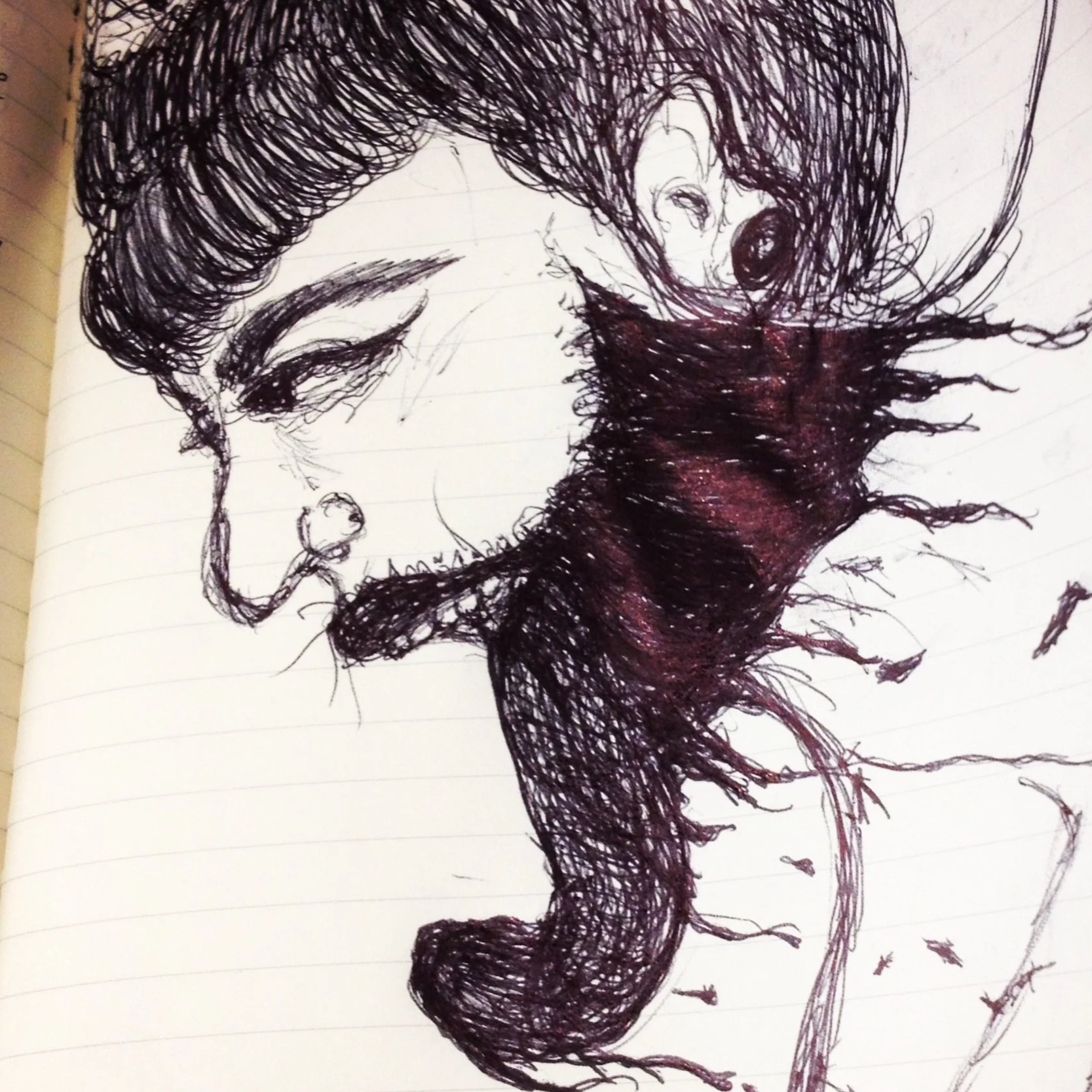


In generational trauma, grief, healing, spiritual reclamation Tags love, Latinx writer, bari, nahua, diaspora, soulmate
Comment

Self Portrait- 2013(?)- Evy Gonzalez Ronceria

Kill My Soul

July 8, 2026

A portrait here.

See my soul
screaming at me
for all the times
it was asked
if what it was saying
was true,

only to have
its mouth sewn shut
before answering,

to be told
to shut up,
to stop lying
to the poor girl,

to stop messing
with her mind
again.

You see them here,
ripped open,
yelling
at all you naysayers,
from their pit
up through her gullet,

and still… you…

Still,
you doubt?

Will you not stop
until you’ve killed her?

In CPTSD, body horror, feminine horror, grief, healing, loss, sexual abuse Tags poem, poetry, trauma, intergenerational trauma, generational trauma, SA
Comment

La Llorona Cargando a Su Cubo-Evy Gonzalez Ronceria, 2013

Mujer Contra Mujer

June 3, 2026

Content Warning: This essay discusses sexual assault, childhood sexual abuse, domestic violence, victim-blaming, and family trauma. Some sections may be emotionally difficult to read. Please take care of yourself while reading.

Author’s Note: This essay reflects on inherited blame, maternal wounds, and the impossible work of loving someone without carrying what belongs to them.

Cuando le dije a mi madre
(when I told my mother)

pensé
(I thought)

que me iba a abrazar
(that she would hold me)

esta vez
(this time)


Pero volteó la cara

e hizo un tsk con los dientes,

tan decepcionada de mí.


Y en pocas palabras me dijo

que era mi culpa otra vez…


Like so many things had been my fault throughout my life.

My dad cheating on her. The abuse I survived as a child. The priest who crossed a line he never should have crossed. All of it. Somehow, all of it had been me.

Except this time, I stood up.

This time, I realized it was not me. I was looking directly at what was to blame.

Or maybe not what.

Maybe where.

For a long time, I blamed my dad. Not entirely, not simply, because even that is not clean. My dad and I have been sitting outside for our balcony smoke sessions for a couple of years now, and lately he has started looking back at his life: his childhood, his family, the way he treated us, the way he raised us, the way he was raised, and how all of that may have shaped the whole dynamic.

A few days ago, he called it una mancha on the family.

A stain.

He said it almost like a curse, like something placed on us. But the truth is, what my dad was naming was a long line of trauma. A long line of hurt people who kept hurting other people. And inside some of those hurt people, there were good people trying to make their way out of the loop, not knowing how, so they continued it instead.

It is painful. It is sad. You can see them trying not to repeat the same malice through their children, but they fail. Then the same wish repeats and repeats, hoping someone will somehow get it right in the next round.

But that is not how it works.

You are not supposed to get it right in the next round. You are supposed to get it right with you.

And that was the message my mother, my father, my grandparents, and their parents never quite understood. That is why all of this is so sloppy. The good is never quite where it is supposed to be, and the malice spills through to us.

As I tried telling my mother that my father was part of the reason I had ended up in the situations I had been in, she looked at me and shook her head no.

I remember that head shake. Always in my father’s defense. It was that same defense that always put him before her children. She never quite understood how dangerous that was. Neither did I, not fully. But as I got older, and now, in what feels like my final, most painful awakening lesson, I saw that the problem was not only him.

That was the part I had not understood until then.

My father may have taught me fear, but my mother taught me how to explain it away. He was the violence. She was the permission. Not because she wanted to hurt me. Not because she did not love me. But because she had been trained to survive by protecting the man who hurt her.

And somehow, that became my inheritance.

As she sat there telling me, “I told you to defend yourself,” and “I never would have let that happen to me,” she defended my father again.

She defended the same man whose violence had shaped our home. The same man whose anger taught us how to shrink, how to listen for danger, how to make ourselves smaller before the room could break open. The same man who hurt her and still somehow remained the person we were expected to love, respect, and protect.

I had to love this man. I had to respect this man. I had to carry the weight of what he did to her, too.

Even as a child, I became part of their marriage. I became the witness. The messenger. The one who knew too much. The one who said something and was blamed for what saying something revealed.

My fault.

I still do not know how to ride a bike. And now, with an inner-ear problem, it is a little harder.

Years later, when I would tell her what happened to me as a child, she would say, “Well, who told you to be alone with him? I told you never to be alone with him.” As if telling me never to play with boys would have stopped me from playing with people my age. As if a child should have known how to protect herself from people she trusted.

You can tell a little girl not to go upstairs with a boy. You can warn her. You can make rules. You can call that protection.

But when you teach that same little girl to accept abuse from her father, you are teaching her something louder than the warning.

You are teaching her to stay.

You are teaching her to doubt herself.

You are teaching her that love and fear can live in the same room, and that if something happens to her inside that room, she should ask herself what she did wrong before she asks who hurt her.

Even after growing up, even after fixing and reframing that, a part of me will still ask the question: Am I the reason? Is it me? And I will always be apologizing for shit men do. Always.

And they will begin to allow it. They have. I have allowed things to happen that, in most situations, I would have stopped. Because I have been afraid to do something. Because I am afraid of what will happen to me. Because I have always been afraid.

I have seen what happens to the door. I have heard what happened to my brothers. I have seen what happens to me. And as rebellious, as loud, as violent as I can be, I am still that little girl. Scared. Frozen. Unmoving. Afraid of what will happen if I scream.

I raised my voice and said, “I’m starting to see maybe you’re part of the reason too. You’re always defending his actions when you should be on the side of your children.”

And then she said what she always says when talking about us:

“I let you live your lives. What you do is your doing.”

I used to hear that as distance. Now I hear it as defense.

It is the kind of sentence that tries to take responsibility off the speaker and place it gently, almost politely, onto the child. As if freedom and abandonment cannot sometimes wear the same face. As if letting us “live our lives” meant we had been protected inside them.

Anyone who knew us growing up would have called my mother overprotective. But she was not exactly protective. She was strict. Paranoid. Performative in the way fear can become performative when it does not know how to become care.

We were not free. We were caged indoors and told it was love.

The worst part is knowing she did want to be there in some form. She did try. But she was never shown how to be emotionally giving or nurturing. She had been taught to mother entirely too young.

She never got to be a kid. She was a mother, a servant, a cook, a seamstress. She was her mother at the ripe age of three or four. A child does not know how to be a mother. A child barely knows how to be a child. Children learn how to be by being, and she never got to.

She molded herself by others and never fully experienced self-expression or freedom. So when she finally came into her own motherhood, she “let us live our lives,” but we did not really go to parks. We rarely went to museums with the family unless it was through school. We had a curfew that was basically: get out of school and come straight home. Not one sleepover. It was weird.

You would swear we were hiding something. And yeah, we were. We were hiding an abusive family. Turns out my childhood friend A was right.

But none of us were aware of it. Not even my mother. To us, this was normal. This was everyday life. This was how you were supposed to be raised, right?

Then, when we were in Colombia, the rules changed. The cage loosened. Family became safety because family was supposed to be safety.

But things happened there.

And when they did, the blame still found me.

Not the adults who may or may not have been watching. Not the people who caused harm. Not the family history that made harm so easy to hide.

Me.

A six-year-old girl.

“No, mami. That does not work,” I said. “Not for this.”

Then she started to say, “So I’m a terrible mother. I can’t do anything right.”

I began to feel the rage come up inside me, but it was not just my rage. I felt her sister’s rage. My great-aunt’s rage. And inside all of it, I could feel my abuelita, her mother. A different emotion altogether. A feeling of having failed somewhere. Missed something. Where did they go wrong for her to treat me this way? I did not have the answers because I was too busy about to yell at my mother.

“Not now, mami.”

I got up and started walking away. My mother started hitting herself on the chest and said, “Well then, just stone me for being a terrible mother!”

I swear you could almost hear her sister’s spirit fill the room, because the ENOUGH was that loud. It vibrated in my body, in everything at that moment.

“Do NOT make this about you when your daughter just told you she was raped!” I said, as I walked out of the room and then out of the apartment with my brother, breathing heavily, gasping, reaching for air.

The disrespect I felt that day is something my mother may never understand.

She may think it was only me she hurt, but in that room, I did not feel alone. I felt the women before us pressing against the walls. Her mother. Her sister. My great-aunt. Elders from our pasts I had never known, all of them watching this same wound repeat itself in another body.

I wondered what they would have said to her.

I wondered if they had ever been blamed for what was done to them.

I wondered where the first woman dropped the ball, and how many daughters had been forced to bend down and pick it up.

Later that evening, my brother volunteered as tribute and tried to mediate a conversation between my mother and me.

He wanted to see if anything could be repaired.

But I do not think repair was possible that night. Not because there was nothing worth saving, but because everything had finally cracked open. There was no putting it back into the shape it had been before.

What had been revealed could not be unrevealed:

I was carrying blame that did not belong to me.

And my mother was carrying blame that did not belong to her, either.

The difference was that I was trying to put mine down.

“You have to realize, mami, what you say has an effect on people,” my brother began.

Almost immediately, before he could finish his next sentence, my mother said, “You are all in charge of your own lives and responsible for your own actions. I’ve done my best. Now I’m treated as a bad mother for saying things.”

We both looked at her and immediately said, “No,” and, “No one said that.”

Then my brother asked the bigger question: “Who said it’s your fault?”

My mother replied, “It has always been my fault. Every time I do something, whose responsibility is it? Mine. Whose fault is it? Mine. When something was done wrong, who would my mother blame? Me. And I would have to figure out a way to fix it. I wasn’t treated like the boys. I wasn’t given chances like everyone else. I always had to do what my mother said, what my father wanted, no matter if it was wrong or right. And they raised me right, and I was grateful for it.”

That was where abuelita dropped the ball. That was the feeling that was not quite the same as the others in the room.

My mother had been living under someone else’s thumb her whole life. She never lived. She wanted to draw, to paint, to design clothing. She never got to. She was so limited. Her creativity was stifled by parents, doctors, priests, nuns, and people who constantly told her she couldn’t, she wouldn’t, she shouldn’t. And for all of those reasons, somehow, it was her fault. She grew to resent herself and the people around her, and to believe they were right. That she was right.

I hugged her.

I hugged her tightly.

I hugged her the way she did not hug me that day.

I hugged her the way my abuelita may have wished she had been hugged. The way my bisabuela may have needed to be held. The way all the women before us deserved to be held before somebody taught them that suffering was duty.

I wanted to tell them I loved them. I wanted to tell them I was sorry anyone had made them believe these were truths they had to live by.

None of them deserved it.

None of them deserved to be robbed of youth, innocence, softness, freedom, or the chance to let their dreams flourish.

But I cannot heal them.

I know that now.

As I released my mother, she looked at me and said, “I’m not going to change, you know.”

I sighed and said, “That’s not the point,” and sat down as we continued talking.

A hug does not magically fix generational trauma and roll us to credits. If it were that easy, man, we could fix everyone real quick. No. It was never about that.

I told my mother it was about what she had just said. “I always thought the reason I had been in so many toxic dynamics was because of my dad’s influence. It wasn’t until your nod in defense of him that I realized it was also your staying with him, how you allowed him to be in our lives, how you allowed him to treat us, and how you allowed abusive men around us, that may have influenced how I allow and cope with abusive people in mine.”

I told her, “I think you did it because you didn’t want Dad to be upset with you. You were afraid of what he’d think, and that fear sometimes mattered more than us.”

My brother said nothing. My mother was in denial. And in myself, I felt that maybe this was what my abuelita thought too. Maybe that is what a patriarchal society does at times. It teaches a woman to hold up her husband before her child. To put her man before her child.

And to throw that at such a young little girl, to beat that into such a young little girl, so impressionable and now so unchangeable—I felt terrible.

I understood the hardest loops I had to break out of because I saw a woman who just could not seem to get out of them herself.

By the end of the week, I was walking my mother to the door after taking her to the nail salon. It had been an awkward outing, filled with one-word sentences and sarcastic remarks back and forth. But by the end of it, she had said something in the salon about us to the manicurist, who just so happens to know all our family—small world.

When my mother said, “I just let them live their life,” the manicurist felt, much like me, that it did not hit the way it was supposed to and laughed at it the way you would laugh at a French dark comedy.

“Oh, Ms. Gonzalez,” she said. “You sure do have a way with sayings.”

As I walked with my mother, something got conjured up in me. Not anger. Not sadness. Just acceptance.

“Mami, I know you’re not going to change,” I told her. “I don’t expect you to. And honestly, at this point in your life, I don’t want you to change for me. I want you to live for yourself.”

I wanted her to write the way she wanted to write. Draw the way she wanted to draw. Sing. Dance. Live that vida loca she always says she is living, but truly live it.

“I don’t expect you to change,” I told her. “I expect you to live. And I expect you to accept that you made mistakes as a parent. That is the part you are having such a hard time doing.”

Saying she let us live our lives was her way of putting down a weight she was still carrying. But there were things she needed to carry honestly. Not everything was her fault. Some things were her responsibility.

“Staying with my dad was the worst mistake you ever made,” I said. “And we were worse off for it. You know that. Accept it. I love you.”

I kissed her on the forehead and walked away.

support/assistance/help if you ever need it ( they will be posted on the other content heavy blogs/ essays as well):

RAINN National Sexual Assault Hotline: 800-656-4673

 988 Suicide & Crisis Lifeline: call or text 988

 Crisis Text Line: text HOME to 741741
 

National Domestic Violence Hotline: 800-799-7233 or text START to 88788

https://pflag.org/resource/support-hotlines/


Call or text 1-844-7NATIVE / 1-844-762-8483. StrongHearts offers 24/7 confidential and anonymous support

https://www.niwrc.org/

https://www.thetrevorproject.org/get-help/

Trans Lifeline: 877-565-8860 in the U.S. / 877-330-6366 in Canada

If you are in immediate danger, call 911 or your local emergency number.

In CPTSD, essay, generational trauma, grief, sexual abuse Tags feminine horror, healing, bilingual poem, essay, self love, cultural resistance
Comment
Tocar El Fondo- Evy Gonzalez Ronceria, 2014

Tocar El Fondo Del Recuerdo- Evy Gonzalez Ronceria, 2014

Not Quite Out of The Thicket.

May 29, 2026

Trigger warning/content note: sexual assault, manipulation, trauma, suicidal ideation, and healing.

Author’s note: This essay comes from a long process of piecing together what my body remembered before I could actually accept and name it. I did not do that alone. I have done it with therapy, family, chosen family, close friends, and time.

I am still in the process of healing. The reason I am sharing this is for the little girl in me who was never able to say anything, and for the thirty-year-old woman who was not able to report it in time. And if this resonates with you, then maybe it’s for you as well.

I know what I can and cannot do with this legally.

But here, at least, I can say it in the present.

Here, at least, I will not be silenced.

L took away the broom, and suddenly it seemed like I could no longer keep anything clean.

Not the floor.

Not the house.

Not the story I had been telling myself.

Everything got so dirty. All my intentions, all the things I had been setting, started falling in on themselves. All the good intentions I had for this place we all lived in. I had been trying to make the house feel better. Safer. More peaceful. More alive. I wanted the energy to change. I wanted everyone to get along. I wanted what had been broken to become something gentler.

“So I’ll get another broom,” I told myself.

But every broom I looked at was wrong.

It had to be that broom.

I didn’t understand why. Not then. I just knew that none of the others fit. None of them had the same bristles. None of them belonged to the house in the same way. None of them held the same intention.

But the truth is, the broom was never the point.

The broom only showed me what I had been trying not to know.

A few months ago, I decided to face the man I had been afraid to name clearly. I thought of it as part of my healing. Some kind of exposure therapy. A way to be respectful. A way to be neighborly. A way to stop letting fear rule the house.

Not because he deserved my softness.

Because I wanted peace.

Because I knew the harm he caused did not come from me. It came from whatever sickness, wound, entitlement, and rot lived in him. I didn’t want or need an apology. I wanted him to sit with himself and learn from himself, the way I was trying to sit with myself and learn from me.

I thought it was going well.

Everything seemed to be coming together.

I had been manifesting good things. I had shaved all my hair off to start fresh. I had told myself I didn’t want any part of him that had touched me. I scrubbed my skin raw in the shower. I got new tattoos. I bought wigs. I dyed my hair. I made cleaning schedules. I started taking care of myself, then the house, then the outside of the house.

I started bringing the healing outward.

I asked if I could plant flowers in the front yard. With permission from the landlord, my brother and I bought beautiful plants, and I began planting them during the weekend. I wanted the house to flourish. I wanted everyone in it to feel something good. Even if I eventually left, I wanted to leave the place better than I found it.

That was the version of me still trying to turn pain into usefulness.

That was the version of me still believing I could cleanse a whole house while lying to myself inside it.

When I saw his car pass, my mind started racing. Should I rush? Should I leave? Should I finish the work the way I normally would — the way I was taught: with good intention, with time, and by letting it flow?

So I stayed.

Eventually, he came out and greeted me.

He had the gall to hug me.

“You know we have our tiffs and all,” he said.

My face twisted.

“Tiffs? Okay.”

I laughed it off because sometimes laughter is the last little bridge between what your body knows and what your mouth is not ready to say.

I invited him to garden with me. I mentioned that I had invited L too, but he had not responded. I said it casually, but I understand now that I have always known how to mention a man when I feel unsafe. Since I was a child, saying a man’s name felt like protection. Like proof that someone else existed near me. Like maybe proximity could make me safer.

But with this man, proximity never protected me.

It only confused me.

He made small comments. Dismissive comments. Comments that sounded casual unless you knew where to look. I know where to look now. I know the difference between a joke and a blade passed gently under the table.

Something that day told me: face him.

Something told me: break the mold.

Not because I should have been alone with him. Not because it was safe. But because some part of me was still trying to understand him. Some part of me wanted everyone here to get along. And that hope did not come from nowhere.

He had mentioned camping.

He had talked about going upstate, about getting away for a weekend, about all of us somehow being in the same place without the sickness underneath it. I could see it like the final frame of a movie: L, my brothers, me, the families, everyone healed, everyone camping, everyone laughing, everyone turning the house into a home.

That was the fantasy he helped place in the room.

The healed version.

The lie I wanted to believe because the truth was too ugly to hold yet.

Before we went to the park, he told me to come inside the apartment. I had not been there in months. I had not even gone in when I came down to thank L for something small that had not felt small to me at all.

I came to thank L for helping me get to work on time, but it turned into thanking him for something much bigger: for helping pull me back to myself. He came to my apartment once when I had been lost for a minute, just chilled for a bit, talking to my brother and me, and that simple act brought me back in a way he probably does not understand. He came in. He gave a damn in his own little way.

And because I had love in me, because I had hope in me, because I had confused endurance with healing more than once in my life, I thought: if I can step into this space and not be sick, maybe I can reclaim something. Maybe I can watch a movie here one day. Maybe I can eat dinner. Maybe I can sit near someone I love without the past choking me.

So I walked in.

I endured.

I felt sick.

I felt scared.

And I held the pressure.

I watched him roll weed, then went upstairs to get ready. I told my brother who I was going out with, just in case, because some part of me knew I was preparing for a battle I was not ready for.

I thought I was walking into clarity.

And I was.

Just not the kind I expected.

We went to the park. He said he liked driving there because no one could see him walking due to workers’ comp. He said he wanted to be somewhere more secluded. He did not tell me to bring a blanket. He brought one seat.

I saw the red flags.

I stayed anyway.

I had my keys. I had my phone. I knew the park well. And that day, I told myself I was not there to talk as much as I was there to listen.

He lit a strain called “Speedy Gonzalez,” and I laughed because of course. Almost kismet. He started talking while watching the volleyball players. He talked about the game, about his life, about how this was his “last summer” because he was leaving in four months.

There it was.

He was leaving.

He was always leaving.

When we first slept together, he said he was leaving. Every time after that, that was the line. He was always going back to Puerto Rico. He was always almost gone. He was always temporary when it was convenient and present when he wanted access.

I clocked the time.

He had told my brother and me in December. Maybe next year. He wasn’t sure. Now, suddenly, it was definitely September.

Something in me was listening differently.

Something in me was finally taking notes.

At one point, I said something I thought was true, but now understand as part of the story I had built to survive him.

“You know I love you, right?”

He looked at me, shaken.

But even that sentence needs context. I had told him before, in Spanish, “Te quiero, como amigo. Te quiero mucho.” I had always meant it that way. As love. As friendship. As love poured into someone I believed was my close friend.

So when I said “te amo,” part of me knew it would throw him off. It was meant to. He was always berating me, saying, “Estás enamorada de mí,” and I knew the phrase would hit his ego somewhere, but also jolt him. Maybe, I thought, it would keep him at bay. But I still meant it from the same place. I meant: I care about you. I have loved you as a friend. You have mattered to me.

But there were also two undeniable truths.

“To be in love, there have to be two people,” I told him, “and you and I are not in love.”

It was something I had always said to him, which I thought would be a clue that I meant it the same way. Between him and me, there were never two people who were in love. There was one person who cared, one person who tried, one person who learned to trust and poured love into a friendship — me. And there was one person who mocked it, insulted it, berated it, and made it something ugly — him.

The other truth was this:

He hurt me devastatingly by telling me the only reason he started being friends with me was for sex. Which means the friendship was just a con. All of a sudden, the way he treated me throughout the years, and particularly after we had sex, made sense.

I mentioned L only to explain the difference. What I felt there was recognition — media naranja — a love that felt whole, whether or not it ever became anything, and I respected it. What I felt with this man was aferrado: clinging, sick passion, attached but not clean.

Maybe that is why every time L came up, the little cuts started.

I had always known how I felt. It could never be more. I gave my trust, my care, my loyalty to a friendship with him. Or so I thought.

The sex was something I had allowed out of trust. Only later was I able to understand those years of trust were years of manipulation.

When he started to explain why it would never work between us, I realized immediately that this outing would be taking an unexpected detour.

I let him reveal himself.

Boy, I wish I hadn’t.

He went on about why he could not love me. Why we were different. Dress styles. Movie styles. Religions. Taste. All of it laid out as if he had ever really tried to know me.

He had not.

We had never gone to see one movie together. I invited him out — to coffee, to walks, to ordinary things friends do when they are trying to know each other better — and he never had the time. I had tried to talk to him about politics, and he low-key told me it was not for women to talk about. I had tried to show him what I liked, and he barely tried to get into it. Even as a friend, he did not try.

And something in me cracked open.

Not because I wanted him.

Because I finally heard him.

And I was free of that sick, clingy poison.

He was telling me, in all his careful little ways, that he had treated me as less than because he saw me as less than. He could soften it. He could dress it up. He could lie through his teeth and say otherwise. But when you do not listen to someone, when you do not give them effort, when you touch their life without honoring their personhood, you have already said what you believe.

The truth is, I am plenty fucking amazing.

The truth is, I am worth everything.

And I am tired of translating someone else’s cruelty into a language that hurts me less.

He talked about L too. Every time L came up, there were comments. Little cuts. He would tell me L did not go out. L did not see people. L would not respond to me anymore. Years before, he had told me similar things. He told me L did not want to see me. He told me not to bother him. He told me L thought I was crazy. He made himself the translator between me and someone I cared about.

I trusted the wrong interpreter.

I trusted him because he stood close to people I loved.

That is one of the hardest truths to hold. I mistook proximity for safety. I thought because he was close to L, close to L’s father, close to the house, close to the story, that he could be trusted with parts of me.

But access is not safety.

Familiarity is not safety.

A man standing near someone you love is still capable of harming you.

For a moment, I thought about calling him a monster throughout this essay because I needed a word big enough for what my body knew before my mouth could say it.

But maybe that gave him too much credit.

He was not a creature from a story. He was not some ancient evil. He was not special.

He was a man.

A man I trusted.

A man who knew how to sound wounded while making me unsafe.

A man who used language, sympathy, trauma, and access to make me doubt myself.

A man who stood close enough to love that I confused him for protection.

And maybe that is the part I have to stop dressing up.

Not because he deserves softness.

Because I deserve clarity.

And that is where it should have ended.

Where it should have ended.

But it didn’t. I was unwell. And I was stuck. Compromised.

And this was right where he wanted me.

Because he wasn’t going to give up unless he tried.

At the park, he told me about his childhood. His heartbreaks. His embarrassments. His traumas. He told me things I know are hard to tell. I know what it means for the body to carry stories it can barely survive speaking.

And still, something in me grew angry.

Not because I had no compassion.

Because I could see where he wanted the story to go.

He let go of my hand because he saw it in my eyes.

I wasn’t buying it.

Still, the child in me wanted to reassure him. I was high. I did not feel well. I was not sure about anything except the old instinct to comfort pain when I saw it. So I leaned in and hugged him. I kissed his forehead.

And then my body remembered something before my mind did.

I moved away quickly.

He laughed and said something sexual. Something vile. Something that turned my compassion into a target.

Who does that?

After saying what he had said?

Who takes a moment of tenderness and makes it unsafe?

I had already told him I was not feeling well while smoking. He knew I was impaired. He knew. And still, he pushed. Still, he watched. Still, he seemed disappointed the outing was not becoming whatever he had imagined it would become.

Near the end of the outing, I kept saying how much clarity I had. I said it was one of the best days of my life because I finally understood him. I went there to sit with my “monster” face to face and say, in my own way, “I see that you are damaged, and I hope one day you sit with yourself, apologize to yourself, and heal.”

Technically, that was the first thing I said right after that “te amo,” and that is where that outing should have ended.

But it didn’t.

It was never going to.

Because he was trying to get something completely different, and he wasn’t getting it. Nothing he was trying was working.

So he tried one more thing.

“One more thing. You remember that night?”

I did not want to repeat it again.

“Yes. What?”

“When you told me you wanted to suck my dick.”

I recoiled.

I started to say what I remembered. That he forced my head to his face. That he forced my hand down his pants.

He interrupted.

He tried to redirect the memory back into something he could live with.

He said I had made it sound like I was only there to talk, not for sex. Like he had violated me or something.

And there it was.

I wasn’t out of the thicket yet. Not entirely.

My body knew before I did.

I went there to talk.

I had not gone there for sex.

I had felt forced from the moment he forced my head to kiss him. From the moment he forced my hand down his pants. I didn’t want to have sex; that’s why I asked if he wanted head. This was not kink. This was not play. There was no permission being asked for and freely given.

There was pressure.

And he knew that.

He knew my history. He knew what I had survived. He knew the places in me that had already been hurt.

And still, he pushed.

I felt forced to keep going. Forced to get on top of him because he wouldn’t cum, because it would not end, because my brain had already gone into that place where the only instruction left was: just get it over with.

“It was what you said.”

My body was yelling at me.

I had softened the truth for him because I had been softening it for myself.

I did not forget.

I refused to call it what it was.

I refused because calling it what it was meant remembering the promise I had made myself: to never let any man touch me like that again.

Because I had made a terrifying promise to myself if a man ever did.

And a man did.

When that truth landed, I needed everyone with me. I couldn’t be alone. I was actually very scared to be by myself. I hated what my brain was doing. I love, however, how my family, therapists, friends, and ancestors/spirit came through. This honestly hasn’t been easy to get through, and with their help, I have been getting through it.

I kept talking down to myself, saying, “I swore I was smart. I swore I was intelligent. I went through this before. Why didn’t I know?” No measure of intelligence, no measure of trauma, could have prepared me for this. My therapists have reassured me that this could have happened to anyone and that this wasn’t my fault. And I have reassured myself of that same fact every day since I have settled with the truth.

People sometimes don’t understand that the body remembers before the story is ready. Sometimes you do not forget the facts. You forget the name. You remember what happened. You remember what was said. You remember the room, the feeling, the sickness, the way your brain said: just get it over with.

But you do not call it what it is.

Not yet.

Because naming it would tear down the whole structure you built to survive around it.

And I had built a structure.

I called it friendship.

I called it care.

I called it love.

I called it healing.

I called it facing my fear.

I called it wanting everyone to get along.

But the truth was simpler and more painful.

I was manipulated by him.

I was raped by him.

It happened.

It is fucking shitty and fucked up and terrible, and it sucks, and that’s putting it so fucking lightly.

And I have to sit with that truth without shaming myself for it.

I loved him. I thought he was my friend.

And now I know I had been convincing myself and everyone I know that I still loved him, and everyone looked at me like something was a tad broken in me, and it turns out, yeah — they were right. He was even more vile than I could admit, and the reality was more than I could handle.

I hated him. I hated myself. I had been dressing that hatred as love because love was the language I knew best. I love genuinely. I love deeply. I pour care into people. I make meaning. I try to understand where pain comes from.

But understanding someone is not the same as excusing them.

Compassion is not consent.

Pain does not make a person safe.

Trauma does not make a person harmless.

And my love was never supposed to be the place where someone else hid their violence.

The day after the park, he checked in. I told him I had onion bulbs for him and to come upstairs. When he did, he stopped on the steps.

“Why only here? Come up to the garden,” I said.

He said there were too many people upstairs.

“It’s my brother,” I told him.

He said it was better when it was just us.

Then I saw him grab himself.

And my brain started screaming.

This was not a misunderstanding.

This was not friendship.

This was not healing.

This was sickness.

He had done something similar before. On New Year’s, I had invited him and L upstairs. He told me L had gone to his room as soon as he heard me knock. He told me he would rather it be just us.

It all got louder.

The pattern started making a sound.

Then came the broom.

L needed it, or said he needed it, for the backyard. I was still trying to finish the front. When he saw me, he retreated. I could feel him looking for distance, and my old fear rose up.

“If you don’t like me, if you don’t want to be around me, just say it.”

There it was again.

The fear of being hated.

The fear of asking and hearing the answer I had been trained to expect.

He reassured me in his own way that he just needed the broom. But when I came back, the broom and dustpan were gone.

And I panicked.

I was angry.

I was lost.

I needed that broom.

Or I thought I did.

But the panic was not about the broom.

It was about the spell breaking.

I had been trying to clean the house with intentions that were not true. I had been trying to fix a problem I could not fix. I had been trying to create harmony in a place where my own body was still telling the truth and I was still asking it to wait.

The broom mattered because it belonged to the house.

But I do not belong to a house more than I belong to myself.

The intentions were not working because I was not setting them for myself.

I was setting them for peace.

For everyone.

For the house.

For the fantasy.

For the photo finish.

For the version where everyone heals because I stayed soft enough.

But I was not setting them from the truth.

The truth is that the loops only stop when I recognize what happened, name it, and stop shaming and hating myself for surviving it.

The truth is that I have to stop silencing myself for men.

Stop writing it only in poetry for the world or my soul to decipher.

Say it simply.

Say it painfully, so I understand.

I was manipulated.

I was raped.

It happened.

I cannot control whether he ever looks at himself and recognizes the harm he has done. I don’t know if I’m the only one he’s done something like this to. I can’t control whether anyone believes me. I can’t control what people do with the truth once it leaves my mouth.

But I can stop abandoning myself in advance.

I can stop making him larger than he is.

He is not a “monster.”

He is a man who harmed me.

And I am a woman who remembers.

A woman who has hated herself for having put herself through this generational bullshit for so damn long.

A woman who is learning to forgive herself for it.

So for that, thank you.

And I also have to be honest: L hurt me too.

Not in the same way. Not in the same place. But he hurt me.

And as much as I love him, as much as I want to give him grace, I cannot use grace to silence myself. I cannot make my love for him another place where I disappear.

I can thank him for the small things that helped me come back to myself. I can love him. I can wish him healing.

But I can also tell the truth: his absence hurt me. His distance hurt me. His silence hurt me.

And I am no longer willing to call that nothing just because I understand where it may have come from.

In Muisca belief, we are all reflections of one another. So if I saw myself reflected in you, L — in your wounds, in your distance, in your light, in whatever part of you I recognized before I had language for it — then maybe you are in for one beautiful ride in this lifetime.

The journey is great, king.

Messy, but beautiful.

Please take it.

With so much love and gratitude.

I have entered a kind of peace in knowing now.

Something I didn’t get when I was younger.

Or a decade ago.

I know it now, through myself in the present.

Through my body.

Through my mind.

Through the part of me that finally understood my love was real, but my endurance was not proof of it.

Through the part of me that finally let the story become plain.

A garden was never going to make the house a home.

The broom was never going to heal the house.

But losing it helped me stop lying to myself.

And that is where everything started looking much cleaner.

support/assistance/help if you ever need it ( they will be posted on the other content heavy blogs/ essays as well):

RAINN National Sexual Assault Hotline: 800-656-4673

 988 Suicide & Crisis Lifeline: call or text 988

 Crisis Text Line: text HOME to 741741
 

National Domestic Violence Hotline: 800-799-7233 or text START to 88788

https://pflag.org/resource/support-hotlines/


Call or text 1-844-7NATIVE / 1-844-762-8483. StrongHearts offers 24/7 confidential and anonymous support

https://www.niwrc.org/

https://www.thetrevorproject.org/get-help/

Trans Lifeline: 877-565-8860 in the U.S. / 877-330-6366 in Canada

If you are in immediate danger, call 911 or your local emergency number.

In essay, grief, loss, sexual abuse, manipulation, generational trauma, CPTSD Tags healing
2 Comments

Frozen Oranges In Little Rooms

May 16, 2026

I was never genuinely good with change.

I mean, from the moment I was removed from my mother’s womb, I reacted by choking myself with my umbilical cord. And when that didn’t work, apparently I was constantly unswaddling myself. I hated — hated — being out of my comfort zone. I have never been one to enjoy when someone moves something in my world.

I have AuDHD, so it’s not always that I will notice and lose it the way my father would. But my body will notice. My body will feel the shift. My body will get emotional and register the loss before I even understand what has gone missing.

Lately, I have been very present in my own life. For a person who tends to anxiously dwell in the past and focus-jump into the void of the future — well, it used to look like a void; now it just looks scrambled, because I never thought I would live this long — the present is actually an amazing place to be.

I realize now that I haven’t always been reflecting so much as drowning in my past lakes. That is why my present was so hard to live in. That is why my future seemed so bleak. It is okay to reflect, but as soon as you feel your old self pulling you in, you have to pull back and walk away. You do not need to dip into, or fall into, any place you no longer need to enter.

And anytime you go back to past lakes that are too dark or too deep, always grab a line and tie it to a strong tree. That way, if you get caught by your reflection, you can pull yourself up and find your way back out.

I have felt more in my body, more in tune, more here, than I have been since I was maybe sixteen or so — before I knew what had happened to me, before I had language for certain violences, before I knew anything about my summers in Colombia as a kid. Even before that age, I was never completely whole. Pieces of me had already been taken, and I had already lived through physical and mental abuse I was well aware of. But I felt there. I lived. I owned myself, and ferociously so.

Today, we were driving through my old neighborhood, and my brother and I realized the old bagel place we went to growing up was closed again. It had been closed for over a month now, and my brother mentioned the old lady who worked there.

I remembered her from elementary school and junior high school. She made the best plain bagel with cream cheese. To me, it felt like heaven: that thick block of Philadelphia cream cheese sliced off and slabbed — PLOP, SLAP — onto the bagel. It did not need to be toasted because it was just that fresh. And it was $1.10.

Yes. $1.10.

I would pass by every once in a while as the years went by, and the years had made her smaller. They had curled her into something that would make anyone’s bones ache. Inflation made the bagel more expensive, of course, but it was still fucking delicious.

I was sad because I hoped the inevitable whispers of Mother had not asked for her return again. Even though I know living in that kind of ache is no life for a woman who spent more than half her life standing and making those delicious bagels — bagels she had made for my older brothers too.

But I also hoped some piece-of-crap mogul had not taken this mother and daughter out of their bagel business.

And then I started to room-inate.

Farther down, we drove to the place where there used to be a swimming pool. It was completely demolished.

There was once a pool there where only white kids went — seriously — because none of us could afford to go. Now it was closed. Gone. Leveled.

We found it interesting that when they finally — finally — made it reasonably priced enough to let everyone in, it only took a few years for them to shut the pool club down and demolish it completely.

It felt like it spoke to something larger about the kind of community we were part of. When I was a kid, I wanted so badly to go into that pool club. I would peek into it all the time and ask my parents why we couldn’t go. As I got older, I started to understand how discriminatory that place was. There was a reason so many people could not get in. The pricing was designed so lower-income people could not access the pool, and since the majority of lower-income people in our neighborhood came from marginalized communities, it made exclusion easy.

As an adult, finding out that this had changed made me happy.

Until they closed it down.

And it made me see that sometimes watching youth thrive where your family had once been denied access is not only a correction. It is a kind of grief too. Because the door finally opened, and then the whole building disappeared.

Roominate.

Then we passed the field.

The field where I used to play with my dogs. Where I spent countless snow days. Where I watched my friends play their team games. Where I ran track. Where I drank until I forgot why I was even there. Where I cut through for shortcuts. Where I played handball. Where I hid away from the problems at home.

It was completely covered up.

“Wonder what they’re doing to it,” my brother said.

I looked at it blankly.

“Probably some commercial development,” I joked.

But then something filled me with dread.

What if it was commercial development? What if it was another building? What if they were taking the field down because it was no longer serving its purpose? What if it was just taking up space, and they needed to build something new?

Roomination.

As we started to make the turn, we saw my favorite place.

The Historical House.

But it looked different too. All the windows were covered. Something was definitely happening there.

The field and the House?

Are they going to take the House?

This house was here when I came back as a little girl. This is the house I pointed out behind Willie in Paris Is Burning and said, “THEY FILMED HERE!”

And he said, “Yes, they did, baby girl.”

Willie, who taught me to be who I am and to never settle for less. The grandest person — and his mom! — you could ever get to grow up around as your neighbor.

I saw that house in all its phases. I met my friend Joel — Pigeon — in that house, and never was a drop of wine wasted there. Words were sold at valuable offers, and boy, were they worth every bit spent.

I miss him daily. I think of him often. And I wondered what would happen if they ever did anything to that Historical House.

After all, that wasn’t its first place of living. The House had its bones somewhere else before its feet were cut, lifted, and placed near my childhood home. It had a rough time getting used to us, but now it has been well over thirty-five years. Now it is comfortable. Now it has found its shape and skin and settled here.

So what is happening to it now?

Room in ate.

Room in ation.

Rooms.

Matt Berninger’s “Frozen Oranges” began to play in the car.

I think the rooms in my mind heard the words before I had a chance to hear them. I began to tear up, and I did not quite understand what was going on. I was having a particularly good morning. We got bagels from the other really good place we love. I felt good. We were laughing and joking around.

So why was I feeling this way?

Then Matt sang about frozen oranges in the trees in Indiana. Crystal apples in the creeks. Swimming in a limestone quarry. Saturday.

And I realized it was, indeed, Saturday.

But more than that, Matt was singing about a memory. About childhood. About nostalgia.

And here I was, in my old neighborhood, in my rooms, watching them tumble down and change all around me.

And I smiled.

I was sad. I was so sad. I was grieving. Because I kept asking, What’s happening? But underneath that, I was really asking: What’s going to happen to my memories? What’s going to happen to all the things I lived? To all the things that happened here? Are they gone if this is gone?

And the answer came almost immediately.

Yes, because it was gone a long time ago.

The moment already happened, babe. You lived it. And as long as you live, the moment lives. And once you’re gone, the moment goes into the memory of all things.

Huh.

As easy as that.

No, it still hurts. Change hurts. But it makes way for some really beautiful things sometimes, so be open to it. Not all change is bad. Don’t settle for less because it is comfortable.

Oh, I’ll never sett—

I’ll never settle.

I said it to myself for the first time in a very long time.

I said it when I was younger, but I do not think I understood the meaning then. Maybe that was it. Maybe that was the problem. Maybe when I was choking myself with the umbilical cord, unswaddling myself, being the ultimate colicky bebé, my spirit was already saying, This body was just not enough, and it did not yet have the language to explain itself.

I was always uncomfortable in myself. People took from me and absorbed me, which made me want to hide more. People would say I was capable of more, or that I was scary, or imposing, because I could speak my mind. Because I could say how I felt. Because I could see through them, or listen, or understand, or whatever gift they wanted from me while resenting me for having it.

I used to cower. I used to get upset. I used to try to be lower. Shut down. Act differently. Mask.

And in the past couple of years, I have decided: truly, fuck it.

I am going to be myself. I am going to love myself and ignore what anyone else thinks or wants me to be. I am going to accept that I am this pure, loving, caring, intuitive, empathetic, bold, assertive person who wants the best for herself and for the people she loves.

And if people cannot get behind that, great. If they can, great too. But if they want to be a dick about it, they can fuck right off. I am not here for their bullshit.

I realized I am capable of change. In fact, I welcome it.

Change is good and needed at times so beautiful things can be born and flourish. We can be the creators of beautiful things in our own lives. We can be the change we choose to see.

And not everything is necessarily changed forever. All we have to do is travel to the rooms in our minds. We can ruminate, yes, but we can also remember beautifully.

I have these little rooms in my head, decorated and lovely, full of thoughts and things and places that remind me of my past. Wonderful things. Angry things. Sad things. All the things that make up me.

And for the first time in my life, I see myself as a monster I can bear to look at — and even love to admire — instead of something I can only other, or speak of in shadows.

I appreciate these rooms because they give me a greater appreciation of my present. They give me love for what I have now, for whom I have around me, and a greater awareness of how I want to spend my time.

They also make me think about my future. But not too far ahead. I am realistic now, and hopeful. I understand that we live in a world changing so constantly that it would be ridiculous for me to think too far ahead. I think as far as I am realistically allowed to think at this point, with how everything is going.

And honestly? It has been a lot better than I thought it would be.

It took me almost forty years for my spirit to finally adjust to my body, and I have to say: choking myself with my umbilical cord might seem a tad dramatic, but looking back and seeing what a dumpster fire this timeline has been, I can understand why the fuck I did such an insane thing.

I would never settle for such a terrible timeline.

So, BRB. I’m going to make something beautiful in this timeline.

Because fuck hoping. We have to make it.

In body horror, grief, blog post, essay Tags nostalgia, essay, self love, change
Comment

Latest Posts

Featured
IMG_3538.jpeg
August 4, 2026
The Spoils
August 4, 2026
Read more →
August 4, 2026
8678A73D-35BD-47AE-895B-06B8363C5BFC.jpeg
July 30, 2026
Siren Song
July 30, 2026
Read more →
July 30, 2026
July 9, 2026
J
July 9, 2026
Read more →
July 9, 2026
IMG_4263.png
July 8, 2026
Kill My Soul
July 8, 2026
Read more →
July 8, 2026
unsplash-image-XL3IZjClcr4.jpg
July 6, 2026
I Have
July 6, 2026
Read more →
July 6, 2026
painting evy 1.jpg
July 1, 2026
Possible Things
July 1, 2026
Read more →
July 1, 2026
C7B1473E-6495-4FEC-BECA-48452FBC473E.JPEG
June 30, 2026
Opening
June 30, 2026
Read more →
June 30, 2026
F10458B4-7F99-44F8-8368-DB682454A157.JPEG
June 25, 2026
Déjate Caer
June 25, 2026
Read more →
June 25, 2026
June 19, 2026
Al Que Me Hizo Daño
June 19, 2026
Read more →
June 19, 2026
canvas (10).png
June 18, 2026
I Will Take It From Here
June 18, 2026
Read more →
June 18, 2026

Powered by Squarespace